Course Description
Modern plant science is increasingly driven by massive genomic datasets. To bridge the gap between field observations and molecular understanding, this course provides a comprehensive foundation for researchers and students looking to master the digital tools of the trade.
Participants will learn to navigate the journey from observable phenotypic traits to in-depth gene family characterization. By leveraging high-throughput computational tools, you will gain the skills to identify candidate genes, analyze evolutionary relationships, and automate complex workflows.
Learning Objectives
By the end of this training, you will be able to:
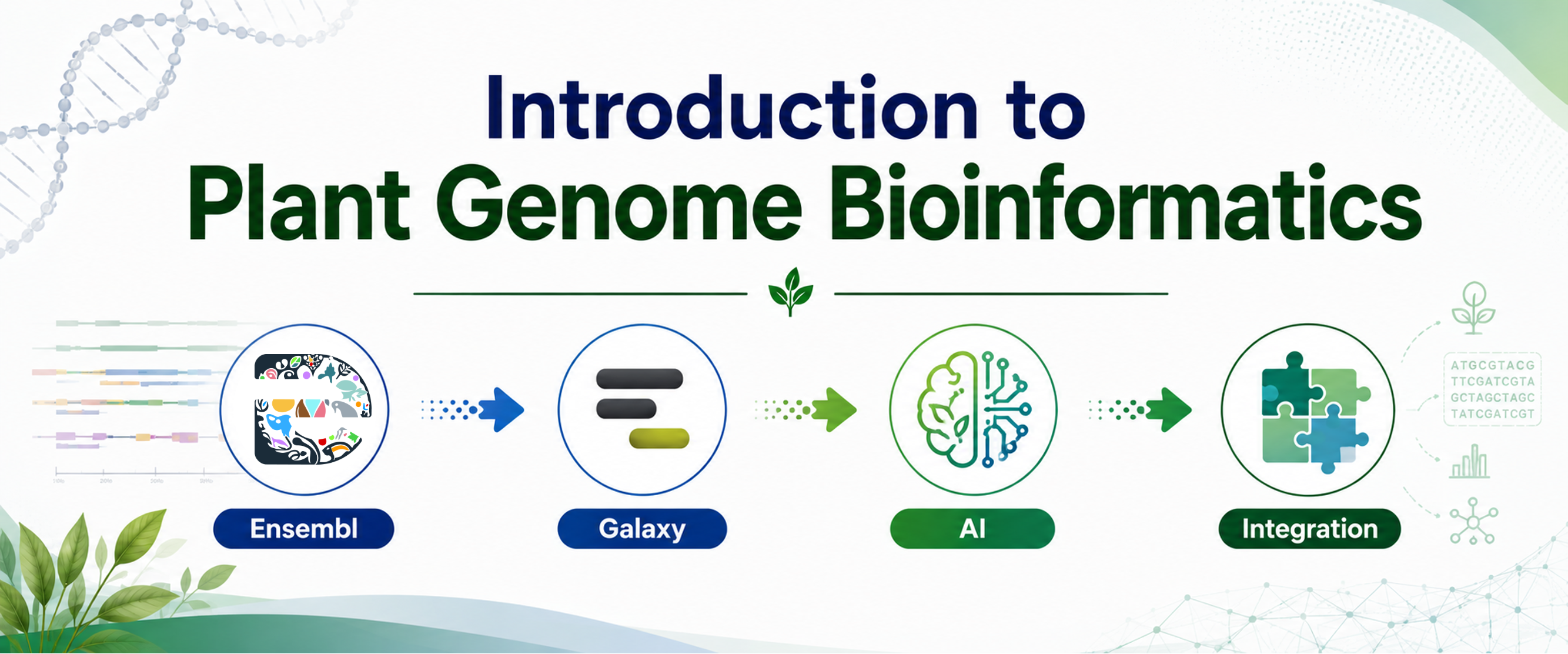
- Navigate Genomic Resources: Utilize Ensembl Data Platform to mine genomic data, identify orthologs, and extract sequences for comparative analysis.
- Execute Standardized Workflows: Master the Galaxy platform for reproducible data analysis, enabling complex bioinformatics without requiring advanced programming skills.
- Integrate AI & LLMs: Leverage Large Language Models (LLMs) and RAG (Retrieval-Augmented Generation) to synthesize biological literature, troubleshoot analysis scripts, and interpret complex results.
The “Traits-to-Genes” Integration
The course concludes with an Integration Workshop where participants select a specific plant trait and trace its genetic architecture. You will identify associated gene families across different species and build a unified analysis pipeline. This holistic approach ensures that you leave with a practical framework applicable to your own research.
Course Modules
- Ensembl Data Platform: Data mining, genome browsing, and comparative genomics.
- The Galaxy Ecosystem: Mastering reproducible workflows.
- AI in Bioinformatics: Prompt engineering for biology and AI-driven data synthesis.
- Capstone Integration: Final project from trait discovery to gene family analysis.
Training Location
Sam-Arng Room
SEARCA
College, Los Baños
4031 Laguna
Philippines